
Centennial Directory Runs
The best documented city directory collections for Centennial research sit in regional and statewide holdings, not in a single municipal shelf. Denver Public Library Special Collections describes Denver city directories from 1873-1923 and householder directories from 1924-1937. Its Colorado Directories Index organizes volumes by municipality, county, and year, but the exact Arapahoe County and present-day Centennial rows still need a volume-by-volume check.
The table keeps known coverage separate from an unresolved local run. A collection may be digitized, held in a library, or available only through a request. The word “Centennial” will not appear in a volume published before incorporation, so the historical jurisdiction belongs in the search note.
| Collection | Years | Where Held | Access |
|---|---|---|---|
| Denver city directories | 1873-1923, with gaps | Denver Public Library | Digitized and collection guidance |
| Denver householder directories | 1924-1937 | Denver Public Library | Address-arranged research collection |
| Colorado Directories Index | Municipality, county, and year guide | DPL index PDF | Use to identify a volume |
| Arapahoe genealogy databases | Varies by database | Arapahoe Libraries | Card, student, or in-library rules |
Known digitized examples include Denver volumes from 1892, 1894, 1896, 1899, 1900, 1905, 1907, 1911, 1915, and 1920, plus 1930 and 1931 householder volumes. Those dates describe the DPL examples, not a complete Centennial run.
Centennial Before 2001
Centennial was incorporated on February 7, 2001, after a 2000 vote approved incorporation by 77 percent. A city directory printed before that date could use Arapahoe County, Littleton, Englewood, Greenwood Village, Cherry Hills Village, or an unincorporated place name. Search the old jurisdiction first, then use a current parcel or map to bridge the location.
This historical switch is more than a naming detail. A newspaper, deed, directory page, or archive catalog may sort a present-day Centennial address under the place that existed when the record was made. A modern ZIP or last line should not be used as the only search term.
The Centennial history page supplies the incorporation timeline. The city newsletter page adds dated community and budget updates that can help place a later directory entry. The county parcel and GIS tools can then test whether an older street or legal description falls inside the current city. Record the historical label, directory year, page arrangement, and modern map bridge together.
Centennial Directory Publishers
Publisher names help distinguish a real city directory from a generic search result. The research inventory identifies Ballenger and Richards examples including the 20th Annual 1892, 24th Annual 1896, 35th Annual 1907, and 48th Annual 1920. Corbett and Ballenger examples include the 22nd Annual 1894, 27th Annual 1899, 28th Annual 1900, 33rd Annual 1905, 39th Annual 1911, and 43rd Annual 1915.
These labels can anchor a family-history note. Write down the publisher, annual number, year, volume title, page arrangement, and holding institution. If the Colorado Directories Index points to a county or municipality volume, verify the scan or shelf record before treating the volume as a direct Centennial source.
The DPL directory collection explains the difference among city, householder, business, and telephone directories. A telephone book may add a later address clue, but its coverage and privacy limits differ from a city directory. A householder run is often the better address tool.
The library’s directory landing page shows how the collections are organized and where a researcher should begin.
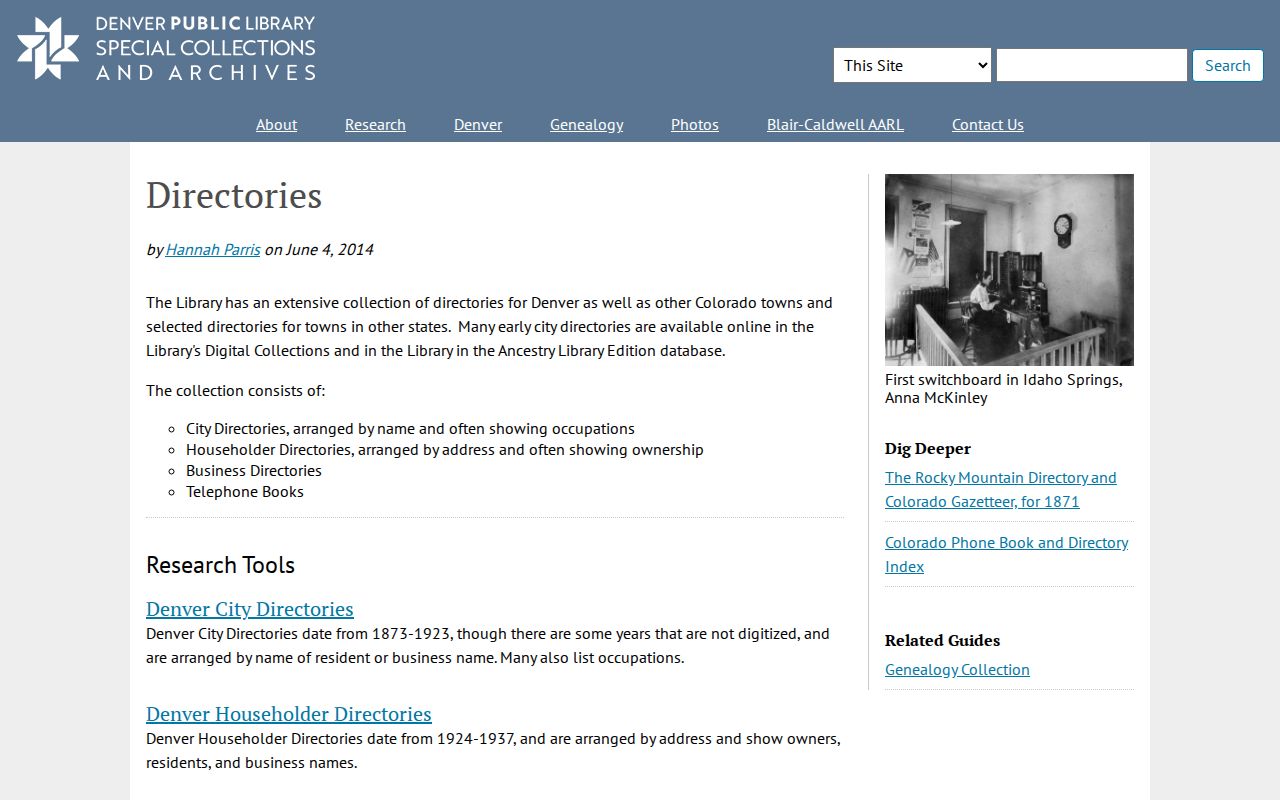
The collection image belongs with the publisher and year note, because a scan without its catalog context can be hard to place.
Reading Centennial Directory Entries
A city directory entry is a compact record, not a biography. The 1887 name-directory sample can show a person’s name, an occupation or business parenthetical, and a residence abbreviation. The street volume then carries street names, intersections, building or business references, and occupants. Later householder pages can be arranged by address and may identify owners, residents, or businesses.
Read the page key before expanding an abbreviation. Keep the entry’s exact spelling, page number, volume, and year. If a person has a common name, compare the occupation, address, and neighboring entries rather than relying on the name alone.
| Name line | The printed name, with spelling and initials preserved. |
|---|---|
| Occupation mark | A business or occupation parenthetical when the volume includes one. |
| Residence clue | An abbreviation or address reference that points to the street section. |
| Street entry | Street, intersection, building, business, or occupant context in an address section. |
| Householder entry | An address-oriented listing that may show an owner, resident, or business. |
- Criss-cross directory
- A reverse section arranged by street or address so a name can be found through a place.
- Householder index
- An address-led directory or section that groups people, homes, and businesses by location.
- Abbreviation key
- The volume’s explanation of short residence, occupation, street, or business marks.
Photograph or note the key before transcribing an entry. A single letter can change the meaning of a residence or business mark, and a page can contain more than one address type.
Centennial Name and Street Pages
The name and street halves of a city directory solve different parts of the same problem. Start with a surname in the resident section, then carry the residence abbreviation into the street section. If the name section does not contain the expected person, try a business heading, a spouse or household head, or an older place label.
The 1887 name volume is useful for the first half of the method. The 1887 street volume supplies the address arrangement. A street entry may mention an intersection, building, or business rather than a household. That distinction matters when tracing a former occupant.
For a current parcel comparison, use the county’s legal description and map only after the historical entry is transcribed. The modern Centennial street records can then be checked as a separate current-address workflow.
Centennial Library Access
The Centennial libraries page lists four Arapahoe Libraries branches: Castlewood at 6739 S Uinta St, Koelbel at 5955 S Holly St, Smoky Hill at 5430 S Biscay Cir, and Southglenn at 6972 S Vine St. The system phone is 303-542-7279. Research notes do not identify a dedicated Centennial local-history room or a complete branch-by-branch city-directory shelf, so call ahead about the item and access rule.
Arapahoe Libraries genealogy resources include Access World News, Ancestry Library Edition, the Colorado Historic Newspaper Collection, Fold3, Heritage Hub, HeritageQuest, MyHeritage, and Newspapers.com Library Edition. Some are available remotely with a library card. Others require in-library access, a student login, or a particular branch condition.
A researcher looking for an old Centennial name should write down the database, date searched, keyword, place label, and whether the result is an index or an image. That makes a later request more precise and prevents a library database from being presented as a complete city directory.
The genealogy page shows why access conditions belong beside the collection name.
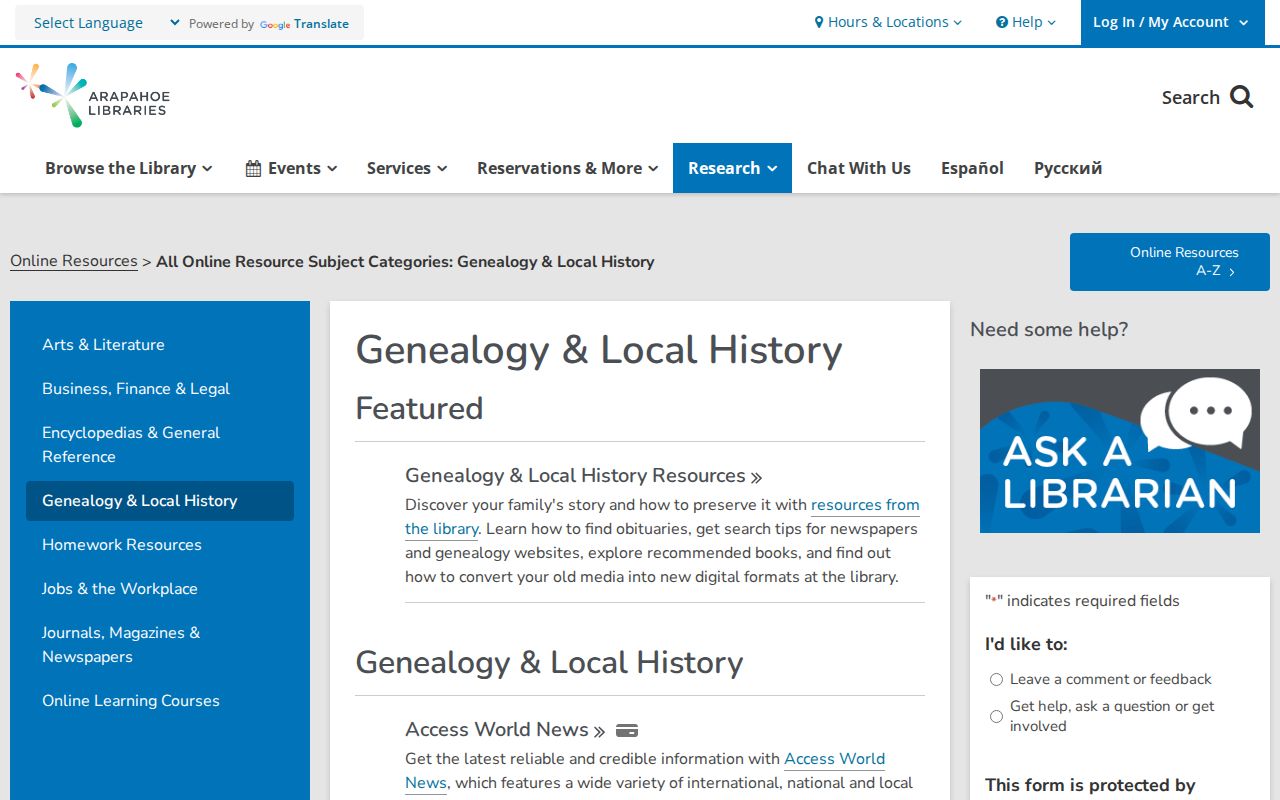
The library image points to a research shelf with multiple databases, each with a different scope and login rule.
Centennial Historical Record Runs
Directories work best when paired with other dated runs. The Colorado Obituary Project contains roughly 50,000 non-Denver Colorado obituaries, mostly from the 1970s-1990s, with full text requested through the library. DPL also lists Denver obituary index PDFs in year blocks from 1913 through 2016 and identifies Arapahoe County Coroner’s Reports from 1876-1891 in its A-Z research guide.
The Colorado State Archives holds selected death material, including statewide death certificates from 1877-1899, a death index from 1941-1948, and Denver or Arapahoe holdings such as Riverside Cemetery plot certificates from 1878-1899, coroner inquests from 1897-1900, and death registers from the late nineteenth and early twentieth centuries. The death-records inventory gives the holding list. These are historical collections, not a current Centennial name search.
The Archives marriage guide identifies an Arapahoe County marriage index from 1859-1901, license application stub books from 1874-1902, and Clerk and Recorder certificates from 1860-1899. A request should include record type, county, year, and spelling. A city directory can suggest a relationship; the archive run can test its date.
The Denver Public Library A-Z guide shows how a broad genealogy collection can point to a narrow county run.
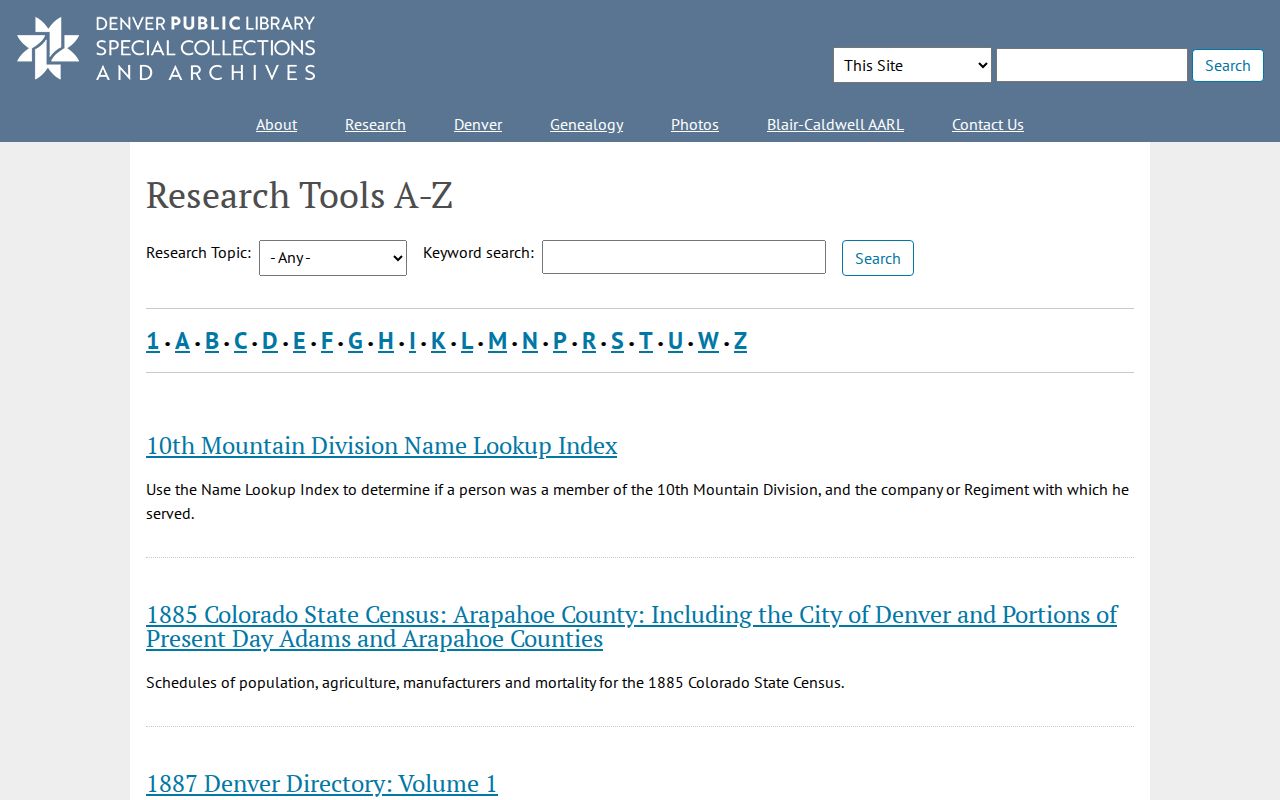
Use the guide to identify a record series, then verify the holding institution, year, county, and access condition before citing it.
- Capture the directory name, year, publisher, page, and historical jurisdiction.
- Search the obituary or newspaper source for a dated event and place.
- Use the Archives record run that matches the county and year.
- Compare the address with a parcel or deed only after the historical label is clear.
Trace Centennial Families Across Years
For family history, a city directory becomes useful when its snapshots are placed in a sequence. Find the earliest appearance of a name, note each address and occupation, then follow the same household through the next available volume. Pair directory years with census years, newspapers, marriages, deaths, or deeds. A gap between volumes is a gap in evidence, not proof that a household disappeared.
Keep the question narrow. “Where did this household appear in this year?” is answerable from a page and a source note. “Who lived here for all time?” is not. A person can be omitted, a name can change, and a street can be printed under an older jurisdiction. The DPL obituary research page can help close a trail, while a current parcel or court source can test a modern relationship.
- Find the name page and transcribe the exact entry, occupation mark, abbreviation, and page.
- Move to the street or householder section and record the address context.
- Check the next available directory year, including a spouse, household head, or business variation.
- Pair the directory snapshots with the nearest census, obituary, newspaper, marriage, or deed source.
- Label the result as a historical appearance and cite the volume rather than implying a current home.
Note: A directory entry can support a year-and-place statement, but it cannot by itself establish current residence or family membership.
Centennial Obituary Trail
Obituaries can connect a city directory entry to relatives, dates, and a last-known community, but their coverage is uneven. Heritage Hub offers obituary and death-notice coverage from 1704 to today with heavy mid-century coverage and original images. Access World News includes Rocky Mountain News from 1990-2009 and Denver Post from 1989 to the present through the library. The Colorado Historic Newspaper Collection has nearly one million digitized pages and more than 200 Colorado titles, primarily from 1859-1923.
Use an obituary as a trail endpoint, then verify the source, publication date, location, and relationship language. A name match in a newspaper does not prove the same person lived at a particular modern address. For a current or restricted vital record, return to CDPHE or the correct county custodian.
Littleton Museum provides another neighboring historical source with more than 60,000 objects, photos, and documents. Its research examples show how deeds, photographs, biographies, and house addresses can work together. Label Littleton material as Littleton or its earlier locality even when a modern map places the area near Centennial.
Verify Centennial Directory Names
A city directory entry should be verified according to its purpose. For a historical address, compare the street section, parcel legal description, and recorded transfer history. For a family relationship, use an obituary, marriage run, or archive source. For a current person-record relationship, use the role-specific Centennial resident lookup route and keep the historical entry marked as historical.
The strongest source hierarchy is a named government record, official archive, library scan, or court request. Copied indexes can be useful finding aids, but they may omit pages or preserve a transcription error. Save the volume title, publisher, year, page, URL, access date, and any image or catalog note.
Directory research works because it preserves context. A name, occupation, address abbreviation, householder line, obituary, and deed can form a careful chain when each item is dated and labeled. The chain becomes misleading when it is compressed into a timeless resident claim.